


Gold prices have been on a strong upward trajectory, but the market is now facing growing expectations of a correction, with key technical and fundamental factors indicating the likelihood of a dip. Fawad Razaqzada, a market analyst at StoneX Group, suggests that while a downward correction appears imminent, certain key support levels should help prevent a sharp decline. Here’s a deeper look at the current market conditions and factors influencing gold’s future trajectory.
According to Razaqzada, the case for a correction in gold is becoming increasingly convincing. He highlights several reasons why the yellow metal might face some short-term weakness. Firstly, there is a lack of clear catalysts for a significant drop in the U.S. dollar. The Dollar Index has recently experienced one of its strongest weeks in months, and with inflation data unlikely to significantly impact rate cut expectations, gold seems overbought on multiple timeframes. This overbought condition makes a correction highly probable. However, Razaqzada also points out that geopolitical risks remain high, which should continue to support gold prices during any dips, balancing out the bearish factors.
The catalyst for this market shift came in the form of Friday’s U.S. jobs report, which resulted in gold losing some of its recent gains. The strong nonfarm payroll report, which showed an unexpected rise of 254,000 jobs, coupled with an upward revision to previous data, surprised many market participants. This unexpected news complicates the Federal Reserve’s narrative of a cooling economy, adding uncertainty to future rate cut expectations. As Razaqzada noted, the Fed is now unlikely to introduce another 50-basis-point rate cut this year, as the labor market remains resilient.
Despite the rise in the U.S. dollar following the report, gold found some support, aided by buyers stepping in and pushing the price back up. Similarly, silver also saw a notable rally, nearly breaking the $33 mark, but eased off as traders took profits ahead of the weekend. Razaqzada believes that the Fed is in a difficult position, trying to balance inflation concerns with the need to sustain economic momentum.
The recent rise in crude oil prices, spurred by increased geopolitical tensions in the Middle East and major stimulus programs by China, has also put inflation back on the radar. This creates a complicated scenario for the Fed, which cannot afford to be too aggressive in raising interest rates without risking a slowdown in economic growth.
Looking ahead, Razaqzada sees gold facing a precarious balance between risks of further price declines and the ongoing support provided by geopolitical uncertainty. “If the Fed becomes more cautious and shifts away from tightening policy further, this could put pressure on gold in the short term,” he said. However, with ongoing geopolitical risks in the broader market, any downside for gold may be capped, especially in the short term.
Key upcoming data points are likely to influence gold’s price movement in the near future. One of the critical reports is the U.S. Consumer Price Index (CPI), due on Thursday. It’s expected that inflation will show signs of cooling, with a year-over-year reading of 2.3%, down from 2.5% in August. Should inflation come in softer than anticipated, this could prompt a dovish sentiment in the market, potentially providing an upward push for gold. Additionally, Friday’s University of Michigan Consumer Sentiment report will shed light on consumer perceptions of the economy, which are closely tied to future Fed policy decisions. A drop in consumer confidence could weigh on economic activity and influence the Fed’s approach, potentially benefitting gold.
From a technical perspective, Razaqzada maintains a bullish outlook on gold, but he acknowledges that the metal is currently in an overbought condition. The Relative Strength Index (RSI) for gold stands at over 80, indicating extreme overbought levels that historically lead to a period of consolidation or selling pressure. Gold has not been this overbought since the peak of the pandemic in 2020, and the correction that followed that period was significant. Although the RSI suggests a correction could be looming, Razaqzada emphasizes that it doesn’t signal an immediate sell-off. The market requires further confirmation of a trend reversal before any substantial bearish action can be expected.
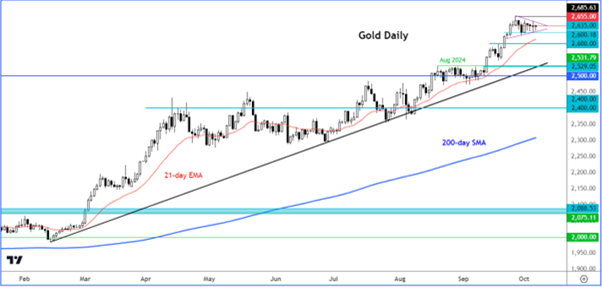
Looking at potential support levels for gold, Razaqzada points to several key technical levels to watch. In the short term, the $2600 mark is crucial. If gold breaks through the support level at $2635, this could signal further downside, with the $2530 level acting as a key bullish trend line from earlier this year. The psychological $2500 level is also significant and could serve as a strong point of support should gold continue to pull back.
While the shorter-term outlook appears uncertain, Razaqzada notes that, according to longer-term charts, gold appears to be due for some profit-taking. He explains that when the RSI surpasses the 70 mark on higher timeframes, it often leads to a period of consolidation or downward pressure to alleviate overbought conditions. The current monthly RSI for gold is over 80, indicating that gold is in overbought territory. Such extreme conditions are rarely sustained for long without a correction, and the period following such levels tends to be marked by a pullback or consolidation.
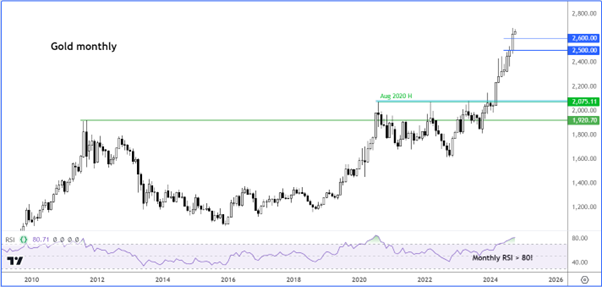
However, Razaqzada also cautions that while the RSI indicates that a correction might be coming, it is not necessarily a sell signal on its own. He stresses the importance of watching for confirmation of a reversal on shorter timeframes, particularly daily charts, before deciding to exit positions. As of now, gold remains in a strong uptrend, and predicting how high it could go before a significant pullback remains difficult. That said, Razaqzada expects some consolidation or a brief dip before gold resumes its upward momentum.
For traders and investors, Razaqzada suggests being cautious but not overly bearish. He recommends taking profits at the first signs of weakness while maintaining a long-term target of $3000 for gold. He would prefer to see a pullback before gold resumes its upward push, as this would shake out weaker hands in the market.
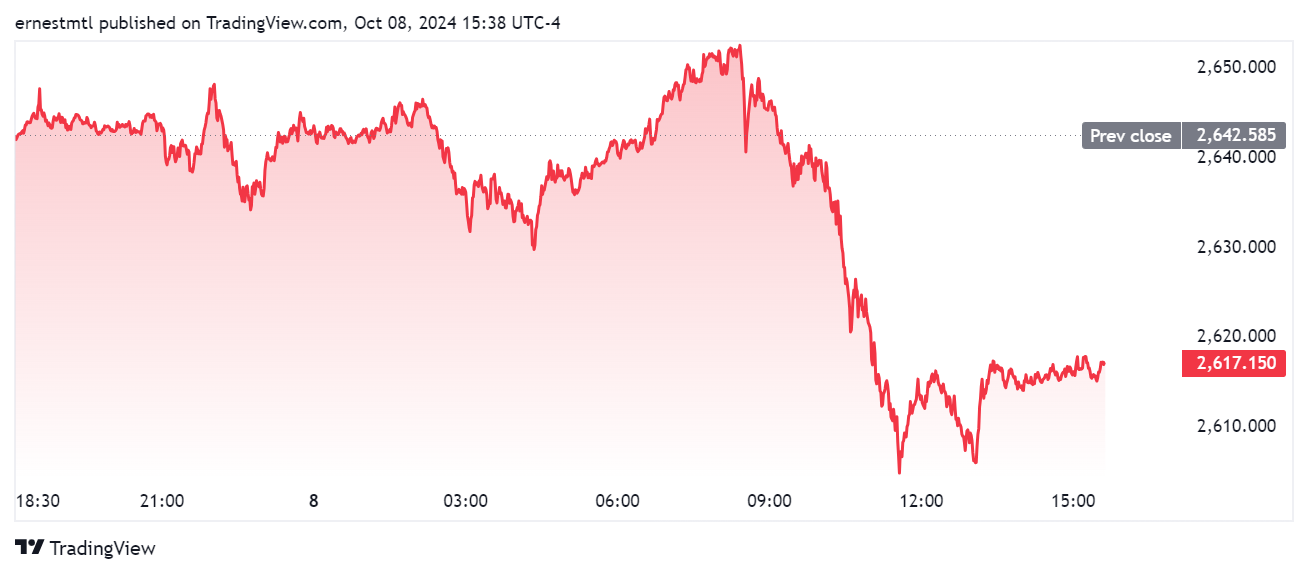
Recent trading activity has shown gold prices experiencing selling pressure, with spot gold falling from a high of $2,653.11 early in the day to a low of $2,604.82 by late morning. As of the latest figures, spot gold is trading at $2,617.10, marking a daily loss of 0.96%. The market remains cautious as traders assess the potential for further corrections and future economic developments.
In conclusion, while gold may face some short-term selling pressure and corrections, key support levels should help limit the downside. Traders and investors will need to stay vigilant, monitoring both technical indicators and broader economic developments, as they continue to shape the precious metals market.